
Choosing a China Best Family Manual Toothbrush Manufacturer requires more than comparing prices or counting product models. A dependable supplier combines practical design, stable production, and clear quality evidence. The Family Manual Toothbrush should feel comfortable in a child’s small hand and secure in an adult’s grip. Rounded bristle tips can help reduce unnecessary gum irritation. Soft, medium, and age-specific options support different household needs.
Dr. Nigel Carter OBE, a respected oral-health authority, has said, “Brushing twice a day is an essential part of maintaining good oral health.” A responsible manufacturer should reflect this daily reality. Handles need balanced weight, smooth edges, and reliable grip patterns. Bristles should be tested for softness, trimming consistency, and secure anchoring. Manufacturing records, material declarations, and batch inspections also matter. These details are not decorative. They influence trust.
Look beyond the sample.
An experienced Chinese manufacturer should explain its testing process, production capacity, packaging controls, and customization limits. It should also understand international product-safety expectations without making careless compliance claims. Good suppliers welcome factory audits and provide traceable documentation. Still, no factory is perfect. Small defects may appear, and a polished catalogue cannot replace independent inspection. Buyers should review samples after repeated use, not only after opening the box. A family toothbrush can look excellent yet feel awkward beside a bathroom sink. That is where honest evaluation begins. The strongest partnership develops through testing, feedback, and steady improvement, rather than promises of perfection.
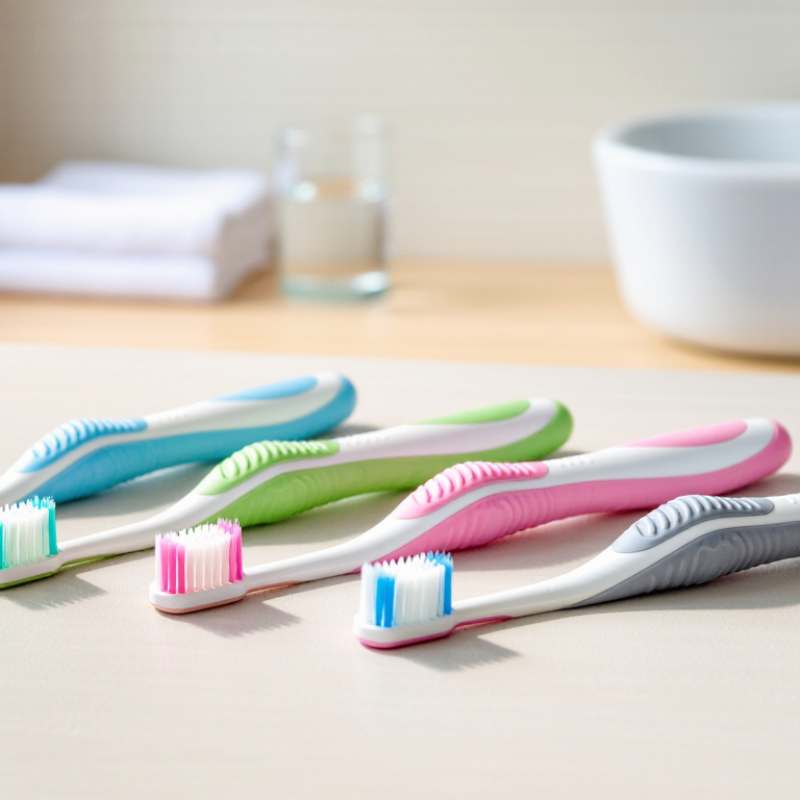
Family manual toothbrush manufacturing covers more than handle molding and bristle insertion. It includes material selection, ergonomic design, trimming, packaging, testing, and batch traceability. A reliable manufacturer should understand household needs, from compact children’s brushes to larger adult handles. Different users need different softness, grip shapes, and head sizes. Comfort matters every morning.
Manufacturers in China commonly work with food-contact suitable polymers, nylon or other tested bristle materials, and controlled colorants. Quality teams should check bristle tufts, handle strength, sharp edges, and end-rounding performance. Pull-out tests help confirm that bristles remain secure during normal brushing. Visual inspection still matters. Small defects can hurt trust.
Industry compliance should reflect applicable Chinese requirements, ISO toothbrush standards, and the regulations of the destination market. Factories should maintain supplier records, production samples, inspection reports, and corrective-action procedures. Independent laboratory testing can support material safety and performance claims. Experience shows that packaging and transport also deserve attention; crushed heads may appear after a long shipment. No factory is perfect. A missed inspection point can reveal a weak process, not just a single defective brush. Manufacturers should review complaints honestly and improve equipment, training, or sampling plans. Reliable production grows through evidence, not attractive claims.

Family toothbrush design should begin with pressure control, not decoration. Soft nylon filaments measuring 0.15–0.20 mm can reduce scraping sensations on sensitive gums. However, diameter alone does not define softness. Filament taper, tuft density, end-rounding, and trim height also matter. The World Health Organization’s Global Oral Health Status Report 2022 estimates that nearly 3.5 billion people live with oral diseases worldwide. A carefully engineered family brush can support safer daily cleaning, especially for users who brush too forcefully.
In production, we examine tuft anchoring, filament recovery, and handle balance through repeatable testing. ISO 20126 covers general requirements and test methods for manual toothbrushes, while ISO 22254 evaluates resistance to tuft deflection. These standards help replace visual guesses with measurable checks. A handle should fit a child’s smaller palm and an adult’s broader grip. Rounded shoulders, a non-slip surface, and a controlled neck angle can reduce wrist twisting near the back molars. Small details matter.
Our early grip samples were too smooth when wet. That mistake was useful. Texture can improve control, but excessive grooves may collect residue and complicate cleaning. We now review grip comfort with different hand sizes and brushing angles. Still, no design suits every family. More user testing is needed, particularly for older adults and people with limited dexterity.
China Best Family Manual Toothbrush Manufacturer
Manufacturing Quality Control Under ISO 20126 Toothbrush Requirements
Reliable family toothbrush production begins with controlled materials and repeatable inspection. ISO 20126 provides general requirements and test methods for manual toothbrush performance.
Our quality team checks filament diameter, tuft placement, handle strength, and trimming accuracy. Every batch receives incoming material inspection before molding or bristling starts. We also examine handle surfaces for sharp edges, cracks, and incomplete molding.
Small defects matter.
During production, operators use visual checks and measured sampling. Tests can evaluate bristle retention, resistance to normal use, and the security of attached components. Calibrated tools support consistent results, while batch records connect materials with finished products. This traceability helps identify problems before shipment.
Family products require practical thinking. Children may bend handles. Adults may apply excessive brushing pressure. Therefore, design reviews consider grip comfort, rounded bristle ends, and stable tufting. Packaging checks also protect bristles from deformation during storage and transport.
Our process is not flawless. Human inspection can miss a minor defect, especially during busy shifts. We reduce that risk through training, random rechecks, and corrective action reports. Sometimes, a failed sample reveals a weak assumption in the process. That lesson should change the next production run, not disappear in a file.
ISO 20126 covers general requirements and test methods for manual toothbrushes. The chart presents the main quality-control dimensions commonly assessed during manufacturing, including visual and dimensional inspection, bristle safety, tuft retention, chemical resistance, and mechanical durability. Results should be verified through documented laboratory and production-batch testing.
A reliable family toothbrush manufacturer must treat safety as a daily production discipline. Soft, rounded bristles can reduce gum irritation when properly finished. We inspect trimming quality, handle edges, brush head strength, and material consistency. Small details matter.
Packaging also protects users before the product reaches the bathroom. Each pack should show age guidance, usage instructions, material information, and clear batch identification. Multilingual labels help distributors avoid confusion across global markets. We use sealed packaging to reduce dust and handling risks. However, recyclable packaging claims need careful verification. Green wording without evidence can weaken customer trust.
Compliance work should begin before mass production. Our quality team reviews destination-market requirements, test methods, labeling rules, and documentation needs. Independent laboratory testing can examine materials, bristle retention, sharp edges, and chemical safety. Factory records connect raw materials with finished batches. This traceability supports faster investigation when questions arise.
Experience has taught us that checklists are useful, but never complete. A supplier change may create an overlooked risk. One weakness remains. Packaging designs sometimes prioritize appearance over readable instructions. We now review samples with production staff, quality engineers, and overseas buyers. Their practical feedback often reveals problems that office reviews miss. Reliable export service depends on repeated testing, honest records, and the willingness to correct small failures before shipment.
Global compliance and packaging reference table for family manual toothbrush products
| Market / Region | Key Safety and Compliance Framework | Family Toothbrush Product Controls | Packaging Requirements and Good Practice | Recommended Compliance Evidence | Reference Source |
|---|---|---|---|---|---|
| European Union | General Product Safety Regulation (EU) 2023/988 applies to consumer products placed on the EU market from 13 December 2024. REACH Regulation (EC) No 1907/2006 applies to relevant chemical substances and articles. | Use ISO 20126:2019 as the primary technical reference for manual toothbrush general requirements and test methods. Control bristle retention, sharp edges, handle integrity, dimensional consistency, and material safety. | Provide traceability information, responsible economic operator details, warnings where applicable, and clear disposal information. Avoid misleading recycling claims and verify packaging material declarations. | Product risk assessment, batch inspection records, bristle pull-out test results, chemical test reports, packaging specifications, technical file, and corrective-action records. | Regulation (EU) 2023/988 Regulation (EC) No 1907/2006 ISO 20126:2019 |
| United States | Consumer products must comply with applicable federal and state requirements. Children’s product rules may apply when the toothbrush is designed or marketed primarily for children. | Define intended user age, inspect for detachable small parts and sharp edges, verify bristle anchoring, and maintain consistent material specifications. Do not make medical or antimicrobial claims without supporting regulatory review. | Include product identification, manufacturer or importer information, country-of-origin marking where required, and age-related warnings for applicable children’s products. | Supplier declarations, material composition records, production inspection reports, test results for children’s products when applicable, and packaging artwork approval records. | U.S. Consumer Product Safety Act Consumer Product Safety Improvement Act 16 CFR Part 1500, where applicable |
| United Kingdom | The General Product Safety Regulations 2005 remain a central general product safety framework for consumer goods supplied in Great Britain, subject to current market-specific requirements. | Apply a documented risk assessment covering mechanical hazards, material safety, foreseeable misuse, hygiene, and product durability. Use a consistent inspection plan for every production batch. | Use accurate English-language instructions and warnings. Keep packaging dimensions stable and protect the brush head from crushing, contamination, and moisture during transport. | Risk assessment, product specification, batch traceability, packaging artwork, supplier declarations, and incident-management procedure. | General Product Safety Regulations 2005 ISO 20126:2019 |
| Canada | The Canada Consumer Product Safety Act establishes general consumer product safety obligations, including prohibitions on products that present unreasonable danger to human health or safety. | Verify bristle retention, handle strength, edge safety, material identity, and foreseeable-use conditions. French and English requirements should be reviewed for applicable packaging and labeling. | Use durable, legible bilingual information where required. Avoid excessive packaging and maintain carton strength suitable for international distribution. | Product risk assessment, bilingual artwork approval, laboratory test reports, material declarations, and distribution traceability. | Canada Consumer Product Safety Act ISO 20126:2019 |
| Australia and New Zealand | Consumer product safety obligations are administered under national consumer protection legislation. Product claims must be accurate, substantiated, and not misleading. | Control bristle shedding, handle breakage, sharp edges, plastic material consistency, and hygiene during storage. Conduct additional review for products intended for young children. | Provide clear use and care instructions, storage guidance, and disposal information. Validate carton compression and sealed-pack integrity for long-distance shipping. | Product specification, test plan, inspection records, claims substantiation, packaging validation, and lot-level traceability. | Australian Consumer Law New Zealand Consumer Guarantees Act ISO 20126:2019 |
| Japan | Consumer products are subject to general quality, safety, labeling, and fair-trade requirements. Product-specific regulatory review is needed when therapeutic or quasi-drug claims are made. | Use controlled bristle specifications, inspect handle and head assembly, and verify that claims remain within ordinary oral-care use unless separately approved. | Prepare Japanese-language labeling where required, including material information, usage instructions, importer details, and disposal guidance. | Japanese artwork review, material declarations, batch records, safety testing, and evidence supporting all product claims. | Consumer Product Safety Association guidance Japanese consumer product and labeling legislation ISO 20126:2019 |
| International Shipping | Export documentation, customs classification, destination-market rules, and transport safety requirements should be confirmed for each shipment and country. | Maintain a stable product bill of materials, production lot code, inspection standard, and sampling plan. Keep finished products clean, dry, and protected from deformation. | Use moisture-resistant inner protection, reinforced master cartons, pallet stability controls, and carton markings for quantity, lot, handling, and country of origin where required. Wood packaging materials should meet ISPM 15 requirements. | Packing list, commercial invoice, carton specification, drop-test or compression-test records, container-loading photos, and ISPM 15 documentation when wood packaging is used. | IPPC ISPM 15 ISO 780:2015 ISO 20126:2019 |
China’s family manual toothbrush manufacturers often support OEM production, from handle color to bristle firmness and printed packaging. Buyers should request material specifications, factory photos, and recent quality records before placing an order. Common MOQ levels vary by handle design, packaging, and customization depth. A standard stock model may require fewer units than a fully molded OEM product.
Lead times usually depend on sampling, tooling, production, and inspection. Samples may take several days, while custom tooling can add weeks. Large orders may require four to eight weeks after approval, but seasonal demand can change this estimate. Export-capable factories should explain carton dimensions, loading quantities, shipping documents, and destination requirements. Ask for a detailed quotation, not only a unit price. Small omissions can affect the final budget. I have found that packaging approval often causes more delay than brushing production.
Tips: Compare at least three written quotations. Confirm MOQ for each color and package. Request a pre-shipment inspection. Check bristle trimming, handle edges, and sealed cartons. Keep approval samples for future comparison. Do not trust a promised lead time without a production schedule.