
 Skip to content
 Choosing the right Polyamide Material is not a simple grade comparison. It is an engineering decision shaped by heat, moisture, load, processing, and cost.
The global polyamide market reflects this complexity. Grand View Research estimated its value at approximately USD 35.77 billion in 2023. The same report projects continued growth through 2030, driven by automotive lightweighting, electrical components, and industrial applications. MarketsandMarkets also identifies nylon 6, nylon 66, reinforced compounds, and specialty polyamides as important growth segments. These figures show demand. They do not identify the correct grade for your product.
Professor Michael F. Ashby, a leading authority on materials selection, offers a useful principle: “The best material is the one that meets the design requirements at minimum cost.” That sounds obvious. It is often ignored.
A practical choice begins with the application environment. A nylon 6 component may perform well in a dry housing, yet absorb moisture near a cooling system. Glass-fiber reinforcement can improve stiffness, but it may reduce impact resistance and complicate weld-line performance. Flame-retardant grades can satisfy electrical requirements, while increasing brittleness or processing sensitivity.
Check the details.
Compare tensile strength after conditioning, not only in dry laboratory data. Review temperature peaks, chemical exposure, wall thickness, and tolerances. Then test molded parts under realistic cycles. A datasheet cannot reproduce every assembly error or humidity change. Sometimes, the cheaper grade becomes expensive after field failure. That uncomfortable possibility deserves attention.
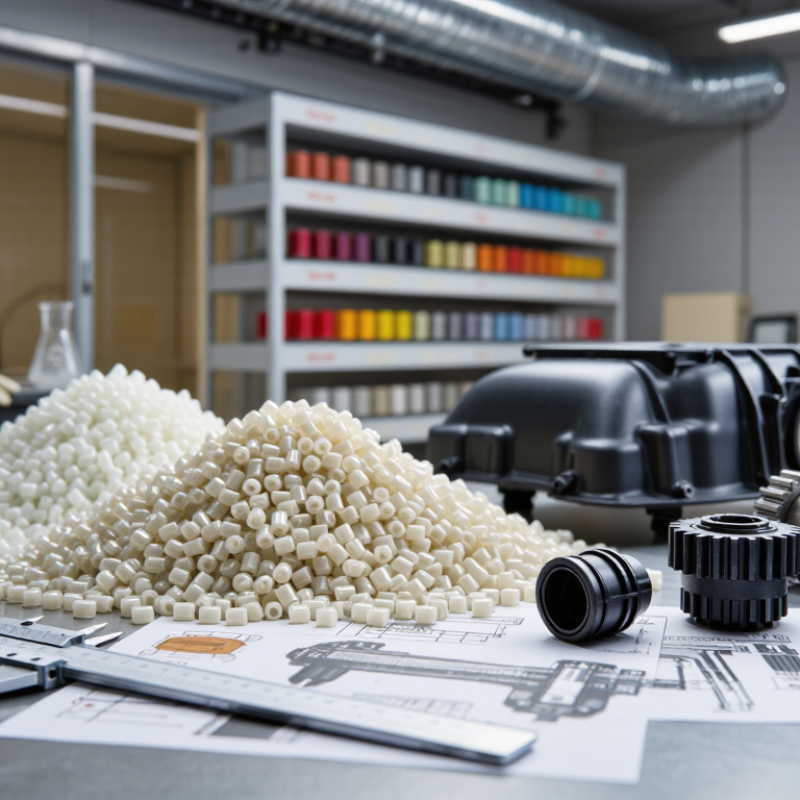
How to Choose the Right Polyamide Material?
Polyamide selection starts with understanding the material family, not just comparing price or strength. Polyamide 6 offers balanced toughness, wear resistance, and processability. Polyamide 66 usually provides higher heat resistance and stiffness. Polyamide 11 and 12 absorb less moisture, making them useful for dimensional stability and flexible parts. These differences matter around a machine, where temperature, friction, and water may change daily.
Reinforced grades add another layer. Glass fiber can increase stiffness and reduce deformation, but it may reduce impact strength and complicate mold filling. Unfilled polyamide often provides better toughness and smoother movement. Most polyamides absorb moisture from air. This can improve impact resistance while reducing stiffness and changing dimensions. I have seen designs fail because engineers trusted dry test data. A controlled test is wiser.
Tips: Check the datasheet for moisture-conditioned values, not only dry values. Compare strength, heat deflection, shrinkage, and chemical resistance. Test the actual part under load, humidity, and repeated movement. Small details count. Also review wall thickness and cooling conditions, because processing can alter performance. No material is perfect. Selection should balance the application’s real demands, manufacturing limits, and expected service life.
| Polyamide Type | Typical Structure and Moisture Behavior | Representative Melting Range | Mechanical Characteristics | Thermal Characteristics | Chemical and Environmental Resistance | Processing Considerations | Common Application Areas |
|---|---|---|---|---|---|---|---|
| PA6 Polyamide 6 | Semi-crystalline polymer with relatively high moisture absorption. Conditioning with moisture generally increases toughness and impact strength while reducing stiffness and dimensional stability. | Approximately 215–225°C | Good strength, stiffness, abrasion resistance, and impact performance. Offers a balanced combination of toughness and cost. | Good short-term heat resistance. Continuous-use temperature depends strongly on grade, reinforcement, load, and exposure time. | Good resistance to oils, greases, and many hydrocarbons. Sensitive to strong acids and affected by moisture, which can change dimensions and properties. | Requires thorough drying before molding or extrusion. Suitable for injection molding, extrusion, and fiber processing. | Gears, bushings, cable ties, machine components, automotive parts, industrial fibers, and general engineering components. |
| PA66 Polyamide 6,6 | Semi-crystalline polymer with high moisture absorption. Moisture conditioning improves toughness but can reduce modulus and dimensional accuracy. | Approximately 255–265°C | Typically higher stiffness, strength, and heat resistance than unfilled PA6. Good fatigue and wear performance. | Higher melting point and better high-temperature retention than PA6 in many applications. Glass-fiber grades provide substantially higher stiffness and heat resistance. | Good resistance to oils, fuels, and many organic chemicals. Vulnerable to strong mineral acids and prolonged hot-water exposure. | Needs careful drying and higher processing temperatures than PA6. Mold design should account for shrinkage, warpage, and moisture-related dimensional changes. | Automotive under-hood parts, electrical connectors, structural housings, bearings, gears, fasteners, and industrial components. |
| PA11 Polyamide 11 | Long-chain semi-crystalline polyamide with relatively low moisture absorption compared with PA6 and PA66. Provides better dimensional stability in humid environments. | Approximately 185–190°C | Tough, flexible, and resistant to repeated impact and vibration. Lower stiffness than PA6 and PA66 but better ductility. | Good low-temperature flexibility and useful thermal stability. Long-term performance depends on grade and service conditions. | Good resistance to fuels, oils, salts, and many chemicals. Good resistance to stress cracking and environmental exposure in suitable grades. | Generally easier to process than higher-melting polyamides. Drying is still recommended, particularly after storage in humid conditions. | Flexible tubing, fuel and fluid lines, pneumatic components, protective coatings, sports equipment, and impact-resistant parts. |
| PA12 Polyamide 12 | Long-chain semi-crystalline polyamide with low moisture absorption. Offers very good dimensional stability and consistent properties in humid conditions. | Approximately 175–180°C | Good toughness, flexibility, impact resistance, and fatigue resistance. Usually less stiff and strong than PA66 but more dimensionally stable. | Good low-temperature performance and moderate heat resistance. Suitable for applications requiring flexibility over a broad temperature range. | Strong resistance to fuels, oils, salts, and many chemicals. Good resistance to stress cracking and moisture-related degradation. | Relatively easy to process by injection molding, extrusion, and powder-based methods. Lower moisture sensitivity simplifies dimensional control. | Fluid and pneumatic tubing, cable protection, connectors, medical components, powder-coated metal parts, and lightweight housings. |
| PA610 Polyamide 6,10 | Semi-crystalline polyamide with lower moisture absorption than PA6 and PA66 because of its longer hydrocarbon segment. | Approximately 220–225°C | Balanced strength, toughness, flexibility, and abrasion resistance. Offers improved dimensional stability over PA6 and PA66. | Moderate-to-good thermal performance, generally between short-chain and long-chain polyamides. | Good resistance to oils, fuels, and many chemicals. Better humidity performance than PA6 and PA66, although moisture still affects properties. | Processing is similar to other injection-molding polyamides. Pre-drying is recommended to maintain surface quality and consistent properties. | Bristles, tubing, cable components, precision molded parts, automotive parts, and applications requiring a balance of strength and moisture stability. |
| PA612 Polyamide 6,12 | Long-chain semi-crystalline polyamide with low moisture absorption and good dimensional stability. | Approximately 215–220°C | Good toughness, flexibility, abrasion resistance, and fatigue performance. Lower moisture sensitivity supports more predictable mechanical properties. | Good thermal stability for moderately demanding applications, with good retention of flexibility at lower temperatures. | Good resistance to fuels, oils, salts, and many chemicals. Performs well where low water uptake and resistance to stress cracking are important. | Can be processed by injection molding and extrusion. Drying requirements are generally less demanding than for PA6 and PA66, but pellets should still be protected from humidity. | Fuel lines, tubing, cable insulation, precision components, connectors, and flexible industrial parts. |
| PA46 Polyamide 4,6 | Semi-crystalline polyamide with relatively high crystallization rate and moisture absorption similar to other short-chain polyamides. | Approximately 285–295°C | High stiffness, strength, creep resistance, and fatigue resistance, especially at elevated temperatures. | High melting point and strong short-term heat capability. Suitable for demanding thermal cycling when the grade and design are properly selected. | Good resistance to oils and many automotive fluids. Moisture can influence dimensions and mechanical properties. | Requires high processing temperatures, careful drying, and appropriate mold temperature control. Processing window is generally narrower than PA6 or PA66. | High-temperature gears, bearings, engine components, electrical parts, and precision structural components. |
| PPA Polyphthalamide | Semi-aromatic polyamide with a more rigid molecular structure. Moisture absorption varies by composition but is commonly lower than that of PA6 and PA66. | Approximately 280–335°C, depending on composition | High stiffness, strength, creep resistance, and dimensional stability at elevated temperatures. Often available in reinforced grades. | Excellent heat resistance compared with conventional aliphatic polyamides. Suitable for demanding temperature and thermal-aging conditions. | Good resistance to automotive fluids, oils, and many chemicals. Performance should be verified for strong acids, bases, and long-term hot-water exposure. | Requires high melt and mold temperatures, controlled drying, and equipment suitable for high-temperature processing. Glass-fiber orientation may affect warpage. | Automotive connectors, sensor housings, fuel-system components, under-hood structures, electrical components, and high-temperature industrial parts. |