
 Skip to content
 A Drawer Beside Bed can turn an overlooked bedside corner into practical, reachable storage. It holds reading glasses, charging cables, medication, and a book without crowding the mattress. More importantly, it keeps essential items within arm’s reach during the night. That small improvement can make a bedroom feel calmer and easier to use.
Professional remodeling research supports this shift toward purposeful storage. The 2024 U.S. Houzz & Home Study shows that homeowners continue investing in functional improvements during renovation projects. The 2024 NKBA Bathroom Trends Report also highlights demand for organized storage, accessible features, and cleaner visual spaces. These reports do not focus specifically on a Drawer Beside Bed. However, they reflect a broader design expectation: storage should support daily routines, not simply fill empty walls.
Design reformer William Morris offered a useful standard: “Have nothing in your houses that you do not know to be useful, or believe to be beautiful.” A well-designed bedside drawer follows that principle. It may include soft-close runners, divided compartments, and a concealed cable opening. Yet a drawer is not magic. It can become a hiding place for receipts and tangled wires. Its value depends on thoughtful dimensions and regular editing.
The best choice considers bed height, walking clearance, drawer depth, and the user’s habits. A shallow top drawer may serve better than a deep, awkward compartment. Materials matter too, especially near lamps, drinks, and daily movement. This guide examines why a Drawer Beside Bed can improve storage, comfort, and bedroom organization without making the room feel overfurnished.
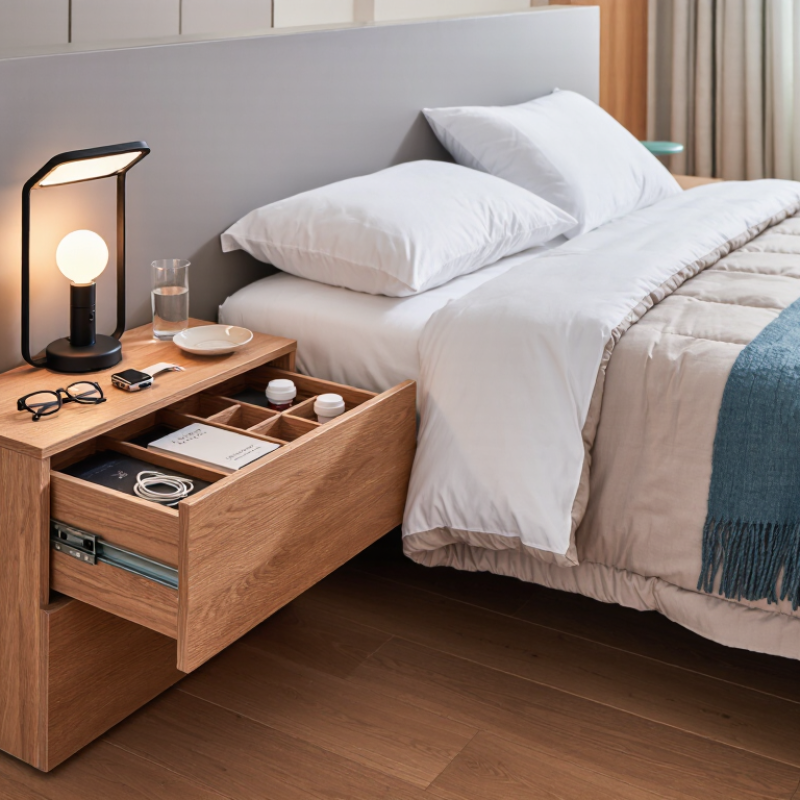
A drawer beside the bed is a compact storage unit placed within easy reach of a sleeping area. It may stand alone, attach to a bedside table, or fit beneath a raised bed frame. Unlike an open shelf, the drawer hides personal items and limits visible clutter. Its purpose is simple: keep nighttime essentials close without occupying much floor space.
In daily use, I find it helpful for glasses, reading books, charging cables, medication, and a small water bottle. A drawer with smooth runners opens quietly, which matters in a shared bedroom. The handle should feel comfortable and remain easy to grasp in low light. Solid construction also prevents the drawer from tipping when it is pulled fully open. However, not every drawer works well beside a bed. A deep compartment can encourage overfilling and make small objects difficult to find.
The best position leaves enough space for walking and cleaning. Measure the gap beside the bed before choosing a unit. Check the drawer’s full opening distance, not just its closed width. Rounded edges may reduce minor bumps during nighttime movement. I once preferred a larger drawer, but it became a storage trap. A smaller compartment proved more practical because it encouraged regular sorting. The design is modest, yet its placement can shape the room’s comfort and daily rhythm.
A drawer beside the bed is a bedside storage compartment, usually integrated into a nightstand or a compact bedside cabinet. The dimensions and capacities below represent common residential furniture ranges and may vary according to construction and layout.
| Data Dimension | Typical Data | Practical Meaning | Storage Benefit |
|---|---|---|---|
| Primary function | Bedside storage for personal and nighttime essentials | Keeps frequently used items within arm’s reach | Reduces clutter on the bed, floor, and surrounding surfaces |
| Typical width | 40–60 cm | Suitable for most standard bedroom layouts | Provides useful storage without taking up excessive floor space |
| Typical depth | 35–45 cm | Allows access beside the bed while limiting obstruction near walkways | Balances storage volume with comfortable movement around the bed |
| Typical height | 50–70 cm | Often designed to align approximately with the top of a mattress | Makes lamps, books, glasses, and devices easier to reach from bed |
| Common drawer count | 1–3 drawers | One drawer suits basic needs; multiple drawers separate different categories | Improves organization for small items, reading materials, and personal accessories |
| Drawer height | 8–20 cm per drawer | Shallower drawers are commonly used for compact bedside items | Helps prevent small belongings from becoming buried or disorganized |
| Approximate drawer capacity | Approximately 8–25 liters per drawer | Capacity depends on the internal width, depth, and usable height | Can hold items such as chargers, books, sleep masks, medication, and accessories |
| Storage accessibility | High; positioned next to the sleeping area | Items can usually be retrieved without leaving the bed | Supports convenient nighttime and morning routines |
| Privacy level | Moderate to high with closed drawers | Contents are concealed from view compared with open shelves | Creates a cleaner appearance and protects personal items from visible clutter |
| Common construction materials | Solid wood, wood-based panels, plywood, metal, or combinations | Material choice affects weight, durability, appearance, and maintenance | Offers options for different room styles, budgets, and durability requirements |
| Drawer operation | Handle, recessed grip, push-to-open, or soft-close mechanisms | The mechanism influences ease of use and noise level | Smooth or quiet operation is useful in shared bedrooms and nighttime use |
| Best items to store | Books, glasses, chargers, tissues, medication, journals, and small electronics | Items are compact, frequently used, and easy to categorize | Makes better use of otherwise unused space beside the bed |
| Space-planning consideration | Leave enough clearance for drawers to open fully | Measure the gap beside the bed and the available walking area | Prevents blocked passageways and allows comfortable everyday use |